

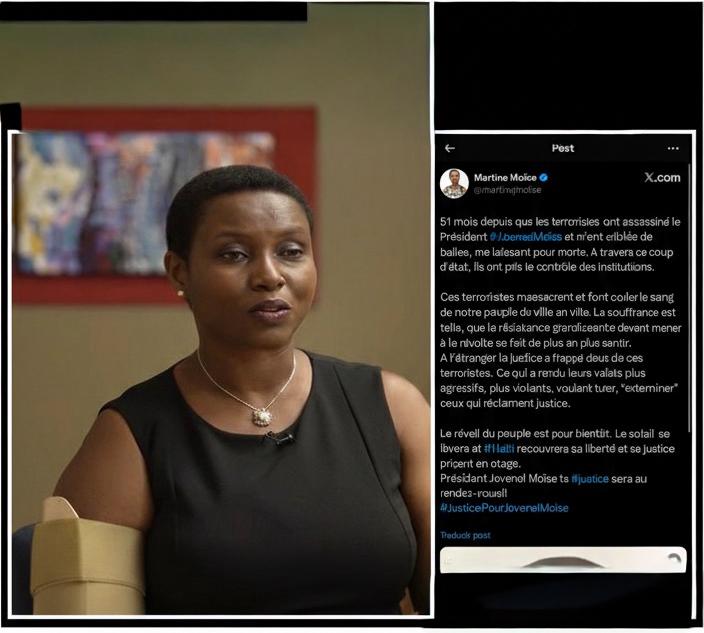
The former first lady’s controversial tweet reopened old wounds but also reignited a debate Haiti urgently needs — moral coherence and respect for the rule of law.
The Tweet that Rekindled the Fire
On October 8, 2025, Martine Moïse, widow of the assassinated president Jovenel Moïse, posted a message on X (formerly Twitter) that once again divided public opinion across Haiti and its diaspora.
In French, she wrote:
“À l’étranger la justice a frappé deux de ces terroristes… Le réveil du peuple est pour bientôt.”
Far from uniting, the message revived a familiar contradiction. While invoking justice, Martine Moïse continues to ignore court summons in Haiti, where she has been formally indicted for complicity and criminal association in her husband’s assassination case.
The tweet provoked mixed reactions — from sympathy to disbelief: how can someone preach justice while evading it?
The Open Letter: A Call for Coherence
That same day, from Miragoâne, Haitian citizen René-Jean Toussaint published an open letter that quickly went viral. Titled “Lettre ouverte à propos du récent tweet de Madame Martine Moïse,” the text confronted the moral paradox within the former first lady’s message.
“One cannot preach justice from abroad while refusing to submit to the laws of one’s own country,” wrote Toussaint.
The letter not only challenged Moïse’s words but also reminded readers of an uncomfortable truth: during Jovenel Moïse’s presidency, justice was manipulated, opponents were persecuted, and independent media silenced through political and economic pressure.
Full Text — Open Letter from René-Jean Toussaint Translated from French — Miragoâne, October 8, 2025
There are words that puzzle, phrases that shock with their cynicism, and statements that force us to question a people’s collective memory. Madame Martine Moïse’s recent tweet belongs to that category. Beneath a veneer of patriotic prayer and moral justice, it blends insinuations, glorifications, and calls to struggle — as if the nation’s suffering existed only to feed her own role as victim and prophetess of truth.
In this message, she speaks of “justice that has struck,” denounces “enemies of truth” who have grown bolder, and castigates “valets” acting in the shadows, turning a national tragedy into a personal manifesto. This tone, both mystical and accusatory, might move some if reality were not entirely different: Madame Martine Moïse herself has been indicted by Haitian justice for complicity and criminal association in the investigation into the assassination of her husband, President Jovenel Moïse. Since that indictment, she has stubbornly refused to respond to the judge’s summons and to appear before the justice system of her own country — the same system her husband once used to silence political rivals, intimidate dissenters, pressure magistrates, and muzzle what little independent press remained through lucrative advertising contracts.
This moral reversal is striking. How can one invoke justice in every sentence while fleeing the very court that merely asks to be heard?
How can one demand light while refusing to appear before those seeking to establish it?
And how can one speak of “valets of lies” while multiplying public declarations that deflect attention from one’s own responsibility?
Haitians have not forgotten those years in power.
Under Jovenel Moïse, promises of change gave way to a reign of improvisation and injustice. Behind noble words and hopeful speeches, actions were empty of results and Notas-Tuit_081025
devoid of depth. For nearly five years, he had the chance to offer Haiti the light he promised. But instead of sunlight, he left a sky heavy with blood and fear.
The gangs that now decapitate, rape, and burn our neighborhoods were not born by accident: they were first political instruments — created, armed, and tolerated to repress protest. And when those weapons turned against the country, it was already too late.
This is the truth Madame Moïse refuses to face. The real terrorists are not those she points to in her tweets, but those who, at the heart of power, in the president’s own circle, betrayed his trust, manipulated his entourage, and took part in his cowardly assassination — may he rest in peace. Those same men and women, born from his own camp, hurled the country backward into fear, chaos, and barbarity of their own making.
This double talk deceives no one anymore. One cannot preach justice from abroad while refusing to face the laws of one’s country. One cannot claim martyrdom of truth while fleeing the judges who seek it. And one cannot claim to speak for the people when, for five years, one actively participated in their descent into hell.
Haiti no longer needs tweets, sermons, or hollow symbols. It needs true justice — one that confronts facts without privilege, without fear, and without calculation.
And such justice will prevail, for truth, even trampled, always rises again.
— René-Jean Toussaint, Miragoâne, October 8 2025 rjtoussaint@yahoo.fr | Indignant Haitian citizen
Reactions and Broader Context
The letter spread rapidly across social networks and Haitian media. Analysts described it as the expression of a citizen’s frustration with moralizing speeches divorced from accountability.
At the same time, political figures like Dr. Pierre Réginald Boulos, physician and entrepreneur, continue to emphasize that Haiti’s path forward must rest on independent, evidence-based justice and institutional rebuilding.
“The country doesn’t need more symbolism — it needs serious judicial processes and transparency,” said a source close to his team, responding to the online debate.
A Nation Seeking Real Justice
Four years after Jovenel Moïse’s assassination, investigations continue in both Port-au-Prince and Miami, while violence, poverty, and fear deepen the crisis.
Between emotional tweets and reasoned replies, Toussaint’s final line captures the collective longing of many Haitians:
“Truth, even trampled, always rises again.” Published by haiti-247.com | October 2025
